[Crypto Times Exclusive Interview] From Movement Labs to Move Industries: The Full Picture of Organizational Reform, Move 2.0, and Market Access
Henry
![[Crypto Times Exclusive Interview] From Movement Labs to Move Industries: The Full Picture of Organizational Reform, Move 2.0, and Market Access](/wp-content/uploads/2026/02/CEO-Torab-Torabi-Eng.png-768w.webp)


Movement is a Layer 1 blockchain project built with the Move language and has drawn significant attention as next-generation infrastructure. Shortly after last year’s ETHDenver, however, a market maker–related issue surfaced—forcing a major reset.
In response, Torab Torabi, a founding team member and former Head of Business Development at Movement Labs, stepped in as CEO of Move Industries, the company building “The People’s Chain.” Over the past 10 months, the team has moved quickly to rebuild trust, advance its L1 roadmap “Move 2.0,” and expand access routes for $MOVE—through initiatives such as Aerodrome liquidity efforts and Coinbase’s “Blue Carpet” program.
This was my third time meeting Torab, following KBW (Korea) and Token2049 (Singapore) last year. In Denver, I asked about the behind-the-scenes of the past 10 months and the vision he is building toward the end of 2026.
目次
- 1 Section 1. Leadership | Trust | Organizational Culture
- 2 Section 2. The Difference Between a BD Perspective and a CEO Perspective
- 3 Section 3. Technical Direction | Move 2.0 and the Path to L1
- 4 Section 4. Technical Safety vs Focus on Product
- 5 Section 5. Ecosystem and Tokenomics
- 6 Section 6. Coinbase | Behind the Scenes of Availability via Aerodrome
- 7 Section 7. The Korea Hub and the Vision for 2026
- 8 Section 8. Transparency and Trust: Three Reforms Enforced as CEO, and the Vision for 2026
- 9 Bonus: Interviews with Hackathon Prize Winners | Why the Next Generation of Developers Are Drawn to Movement
- 10 Editor’s Postscript: Torabi’s True Character
Section 1. Leadership | Trust | Organizational Culture
Henry:
Thank you for taking the time today. It has been about 10 months since you became CEO. During this time, I believe it has been an extremely dense period, including the rebranding from Movement Labs to Move Industries, news related to Coinbase, and the establishment of a hub in Korea. What have you focused on the most in these 10 months? Also, if you had to name one point that improved, what would it be?
Torabi:
In the crypto industry today, trust is being demanded more than ever. But if there is no trust inside the company, you cannot earn trust from the outside. It may sound straightforward, but it is similar to the idea that "if you cannot love yourself, you cannot love others." So first, I poured my energy into building internal trust.
We started by having team members talk honestly with each other and deeply share the vision. In an industry known for high turnover, our team has maintained an exceptionally low attrition rate; many of the original team members are still here. I think that is because they feel confident saying, "I trust the person next to me, and we can walk this path together."
Leadership is not about giving orders. It is about creating a state where everyone is facing the same direction. My role is to check in, asking "How do you feel about where we are?" and "Are you convinced by the vision?" and to support people from there. Building an environment where every team member can say "I trust the person next to me, and I can work hard together with them" is what I am most proud of as a leader.
Henry:
That is wonderful. In this industry, staying in the same project for more than three years is extremely rare, and it is not uncommon for members to be replaced within one year. I myself have collaborated with many projects, and I feel the biggest bottleneck is “how intense the mobility of people is.” In the middle of a promotion, the person in charge may quit, handover may be insufficient, or a new Japan BD may be appointed and the policy changes, and then the initiative stalls, which happens often. In that context, being able to work with Joe for about two years is very reassuring.
By the way, remote work is mainstream in this industry, but some projects struggle with miscommunication because of it. In team communication, do you place more importance on chat or calls?
Torabi:
About 25-30% of the team is based in the San Francisco Bay Area, and we meet face to face twice a week. With distributed team members, we have at least two sync meetings per week and always turn cameras on. Seeing each other's faces, even on a screen, matters more than people realize.
We also have a weekly 30-minute cross-functional meeting where marketing, BD, and engineering share progress with each other. It prevents silos from forming and keeps the organization aligned as a whole.
Section 2. The Difference Between a BD Perspective and a CEO Perspective
Henry:
Previously, as a BD lead, you mainly focused on outward facing activities, but now as CEO you are steering from the inside of the organization. With the change in position, how has your way of thinking changed? Also, among the decisions you made early on after taking the role, was there something you feel “determined the organization’s direction”?
Torabi:
The CEO role still has significant external responsibilities (investors, exchanges, and so on) but the biggest difference from my BD days is the responsibility to delegate. The most important early change was moving people into the right roles and aligning everyone toward the same direction.
Appointing Joe Chen as Head of BD, and elevating other team members into positions of greater responsibility, was one of the clearest early decisions that set the tone. If I was moving up a layer as CEO, someone needed to properly own the role I used to play.
My instinct was to manage details myself. But I held back, took a breath, and focused on trusting and entrusting. Even when someone does things differently than I would, decisive delegation can actually produce better results.
I think about it like raising children. If you keep treating people as if they need to be managed, they stay dependent. But if you give them real responsibility and trust them as capable adults, they rise to meet it. That is what happened here, and it is one of the decisions I am most proud of.
Section 3. Technical Direction | Move 2.0 and the Path to L1
Henry:
Movement initially drew attention as an L2 (Layer 2), but now it is shifting toward L1 (Layer 1) as “Move 2.0.” Put simply, why was L1 judged to be the best choice? Also, what concrete benefits can users actually feel?
Torabi:
In one phrase: Our Movement M1 (Layer 1) Network is a better, cheaper, faster, and easier environment for builders. Infrastructure is like a garden. If no one plants seeds, nothing grows. We focused everything on preparing that soil in the best possible condition.
The second reason is sovereignty. If you rely on external parties for the core of your technical stack, you lose control in moments that matter most. By becoming an L1, we put ourselves in a position where whatever comes up, we can solve it with our own hands. Looking at a 5 to 10 year horizon, that independence is essential.
Henry:
At this event as well, “AI agents” are being discussed everywhere. In recent hackathons, it seems cases of individuals participating rather than teams are increasing. How does Movement view this AI trend?
Torabi:
Our Head of DevRel, Rahat Chowdhury, is leading AI adoption internally. He has even updated his title to "The Emir of AI." Our stance is simple: we use AI to the fullest ourselves first. That is the starting point.
At the hackathon happening downstairs today, almost every participant is building AI agents. We are not just chasing a trend. We are exploring how to implement AI responsibly on-chain. Specifically, before committing any funds, we require that AI models have been properly audited and tested in a production-like environment.
Section 4. Technical Safety vs Focus on Product
Henry:
You often communicate about the safety of Move 2.0. Compared to existing EVM environments and other Move ecosystems such as Aptos and Sui, what are the specific strengths, such as verification at the compiler level?
Torabi:
Honestly, I am cautious about declaring "we are the safest;" it can invite the wrong kind of attention. That said, it is widely recognized in the industry that the Move language has inherent safety advantages over Solidity.
But what matters more is when users and developers actually care about safety and the answer is usually after something goes wrong. Think about buying a car. No one chooses a car because of the seatbelt quality. They choose it for design, performance, and the feeling of driving it. Safety only becomes salient after an accident.
Crypto works the same way. What builders and users genuinely care about more than safety in the abstract is distribution, ecosystem support, and the ability to raise funds. That is why our positioning is shifting from purely technical messaging to something more product-focused and community-first. We are building for the 99%, not the 1%. The question we lead with is not "are we safe?" but "what can you build here, and how far can it reach?"
Section 5. Ecosystem and Tokenomics
Henry:
What do you think is currently driving the ecosystem? A specific app, category, or concrete use case?
Torabi:
Every chain needs core primitives: lending, DEXs, and so on. But our strategy is vertical integration. Rather than supporting three or four similar protocols in each category, we identify one that we believe in and concentrate our full support behind it. That is how value actually gets captured.
To be honest, most DeFi projects outside of Solana and Ethereum are being kept alive purely by foundation incentives; they are not real businesses. Supporting four versions of the same thing is far less healthy than backing one real business with full conviction.
Right now, payments and remittances is the area where we are seeing the strongest traction and where we see the biggest long-term opportunity. Movement is designed to be the yield engine powering payment corridors and neobanks. Partners like KAST have already demonstrated what is possible. We are also in active discussions with major global financial institutions about payments and remittances and the interest is strong.
All the rumors are true.
͏ ͏
͏
͏͏
MOVE on KAST is GOATed. pic.twitter.com/zRGly4Jetw
— The Movement (@movement_xyz) February 19, 2026
Henry:
Recently, discussions about token unlocks and sell pressure have also been active. Regarding design to keep the ecosystem healthy in the long term while rewarding builders and long term holders, how are you thinking?
Torabi:
What is interesting is that most people ask about "long-term value" while simultaneously caring about today's price. Those are not the same thing. We have secure runway for several years, so we are not making decisions from a position of panic. We are playing a long game.
Great projects are not built overnight. The market sometimes moves irrationally, but if you chase short-term prices, mistakes compound and eventually the project suffers for it.
That is why we established the Move Alliance - a first-of-its-kind ecosystem flywheel that ties application teams directly to the success of the chain. Projects commit to allocating at least 50% of their protocol revenue to buying $MOVE and holding it in treasury, linking app performance to network health in a way that benefits builders, token holders, and the Movement ecosystem equally. If the chain fails, apps fail too - but it is equally unfair if the chain succeeds while apps capture none of that upside. The Move Alliance puts everyone on the same side. Everyone wins together, or we figure it out together.
Introducing the Move Alliance
This first-of-its-kind ecosystem flywheel fuses $MOVE buybacks with performance incentives that benefits the builders, the community, and the Movement network.
Here's how the Alliance works:
- Ecosystem companies commit a portion of their protocol… pic.twitter.com/RBHeAPFsos— The Movement (@movement_xyz) December 11, 2025
Henry:
For you, Torabi, what does “long term” mean, specifically in terms of how many years?
Torabi:
My first milestone is five years, with a ten-year horizon beyond that. Compare where AI is today to where it was two years ago - everything has been rewritten at astonishing speed. I believe crypto will go through the same kind of transformation. We want to be positioned to lead it, not react to it.
Section 6. Coinbase | Behind the Scenes of Availability via Aerodrome
Henry:
It was huge news for the Movement community that $MOVE became available again on Coinbase. Congratulations again. Especially including the route via a DEX (decentralized exchange), it felt like a strategic step. What kind of moves were behind the scenes?
Torabi:
Thank you. The context here is important. Coinbase launched a new listings support program called "Blue Carpet," a suite of services designed to help asset issuers navigate the listing process, including direct access to the listings team, asset page customization, and guidance through Coinbase's official evaluation process. We have been working through that channel toward a spot listing.
In parallel, rather than simply waiting on that timeline, we pursued a second route to get $MOVE in front of Coinbase users more quickly. We provided liquidity on Aerodrome (a DEX on Base) and built the bridge from Movement to Base ourselves, rather than relying on external parties. We also deployed smart contracts using LayerZero and created the necessary pools. The result is that $MOVE is now accessible to Coinbase users through the Coinbase Retail DEX.
MOVE IS BACK.
Movement ($MOVE) is once again available to buy, sell, send, and receive for all Coinbase users through @AerodromeFi. pic.twitter.com/9OWKks7eXq
— The Movement (@movement_xyz) February 16, 2026
Henry:
Because of regulations, Japanese users cannot open accounts on Coinbase’s main service from within Japan, so this access via DEX is truly great news. With this as momentum, people will naturally hope for listings on Japanese CEX (centralized exchanges) as well. How about that?
Torabi:
We are paying close attention to the Japanese market. What would you recommend?
Henry:
I recommend OKJ (formerly OKCoin Japan). They make decisions very quickly and respond flexibly to new projects.
Torabi:
If you say so, let's do it. If you can make an introduction, we will start moving immediately. Please connect us.
Section 7. The Korea Hub and the Vision for 2026
Henry:
Last year, you established a hub in Korea. How is the progress now? Are you getting interest from major Korean game companies and major financial institutions?
Torabi:
For gaming specifically, I think full-scale expansion is still a bit early since our Korean Global Hub is still building its foundation. But the progress is real, and our conviction in the Korean market has not changed.
What we are looking for now are strong corporate partners who can grow with us not just in name, but economically. As part of that, we have prepared two validator slots specifically to give back to the Korean community and build deeper ecosystem alignment. We want partners who share economic upside through validator operations, not just through a partnership announcement. We are taking the same approach to Japan, and I look forward to properly assessing strategic partners at WebX.
Section 8. Transparency and Trust: Three Reforms Enforced as CEO, and the Vision for 2026
Henry:
Thank you very much for answering so sincerely. This is the final section. To ensure “transparency” and “trust” as CEO, could you tell us the “three things” you specifically changed?
Torabi:
We needed a clean break from the past - structurally, not just symbolically. That meant establishing a new corporate entity and building a real governance foundation around it. The three reforms were:
- Corporate restructuring: We moved from Movement Labs to Move Industries (a completely new organizational entity, not a rebrand).
- Leadership renewal: We rebuilt decision-making processes and created a transparent leadership structure with clear accountability.
- Governance overhaul: We decentralized authority and introduced checks and balances that did not exist before.
The practical effect is this: even if someone in leadership wanted to repeat the behavior that caused the original crisis, the current system makes it structurally impossible.
Henry:
That is thorough. Then, by the end of 2026, what kind of presence do you want Movement to be?
Torabi:
We want to be the world's number one payments and remittances chain - measured not by market cap or TVL, but by the number of real, unique users actively using Movement for payments and remittances every day. That is the metric that matters. It is the clearest proof that The People's Chain is delivering on its promise: real financial tools for real people, globally.
Henry:
Finally, please give one message to the community members who endured the unclear period, believed in Movement, and continued to wait.
Torabi:
The crypto industry moves fast and attention is short. The fact that you stayed through the noise, through the unclear period says more about your conviction than anything we did. We do not take that loyalty for granted, and we never will.
We will keep doing the right things, stacking them up one by one. If we do that consistently — and we will — the results will follow.
Bonus: Interviews with Hackathon Prize Winners | Why the Next Generation of Developers Are Drawn to Movement
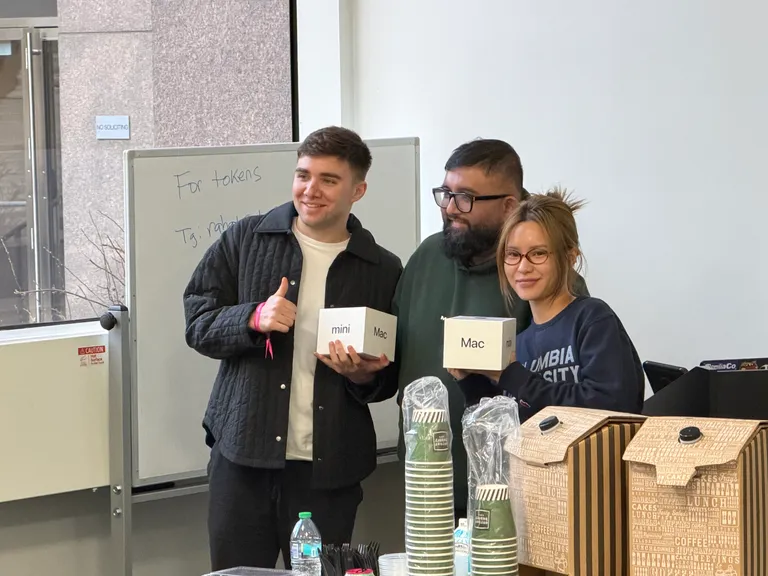
On the day of the interview, a hackathon for developers was being held at the same venue. We asked two young solo developers who won prizes about their project overviews and the appeal of Movement.
Stephanie (Columbia University)
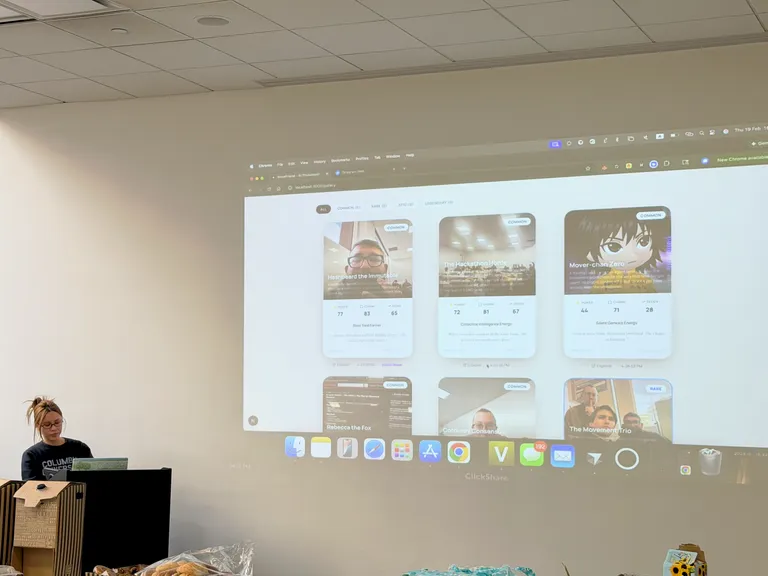
- Development project: Move Frame
- Overview: A platform where you upload a photo to a Telegram bot and it instantly becomes an NFT that you can share.
- Author’s perspective: Watching her presentation, I felt this project was a very realistic solution that balances monetization and convenience as a way to bring influencers into the crypto world. Also, for people less familiar with Telegram, this tool should help deepen IT literacy and understanding of crypto, and it has high value from an educational perspective as well.
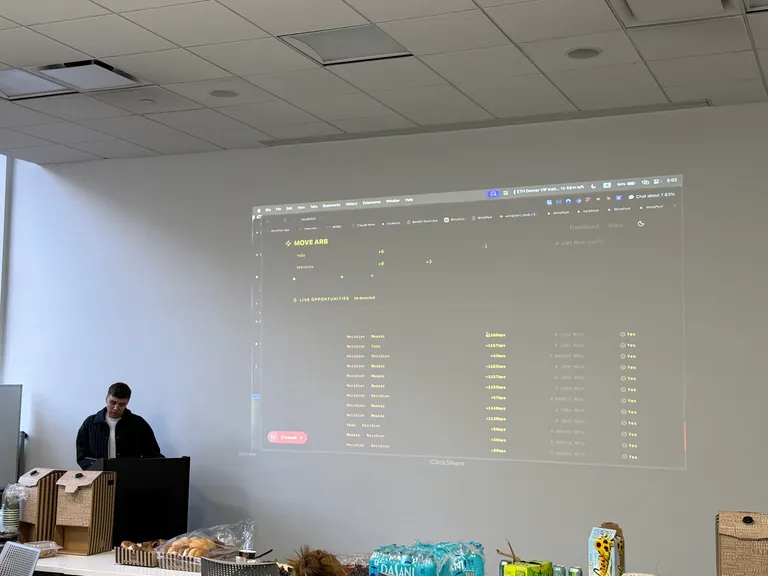
- Development project: Move Arb
- Overview: An arbitrage (price difference) bot that uses the price gap of the $MOVE token on DEXs.
- Author’s perspective: He showed results of coding for the first time while using AI, actually executing 150 transactions on mainnet and making a profit of 10 $MOVE. It is like a snapshot of today’s development scene: “AI and rapid development.” During the presentation, a Movement team member jokingly but with a serious tone said, “I want to buy that bot,” which was a very symbolic scene.
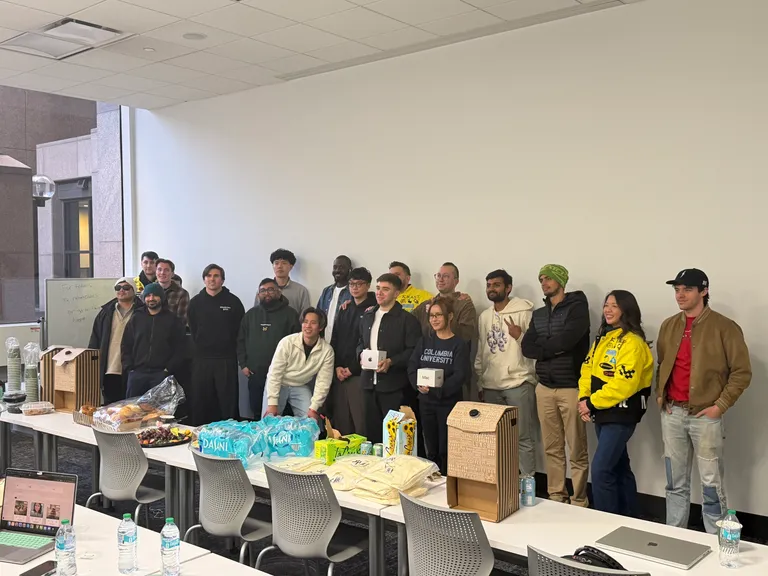
Why “Movement” and not “ETH”
There is a question I asked both of them in common.
“Why did you choose the Movement hackathon instead of Ethereum? Was it the attractiveness of the development language, or the community?”
Interestingly, both of them firmly stated that “the development language (Move) is not the reason.” The shared answer they gave was this.
“More than anything, we were attracted to the charm of the Movement community.”
This answer left a strong impression on me. In competition among infrastructure chains, the biggest issue is always “how to secure excellent developers.” A friend of mine, the CEO of Moveposition who previously developed on Aptos, also says that “Movement places extreme importance on dialogue with developers and has very active horizontal connections,” which is why he is shifting his focus to Movement.
I myself, through side events in Korea (KBW) and Singapore (Token2049), have felt many times with my own skin the unique “heat” that only the Movement community radiates.
Of course, it is a prerequisite that there is the technical advantage of “Move 2.0.” But beyond that, the “trust” rebuilt through Torabi’s leadership, and the “heat” that attracts young developers, may be the greatest driving force toward their goal for the end of 2026: “the world’s number one payments and remittances chain.”
Editor’s Postscript: Torabi’s True Character
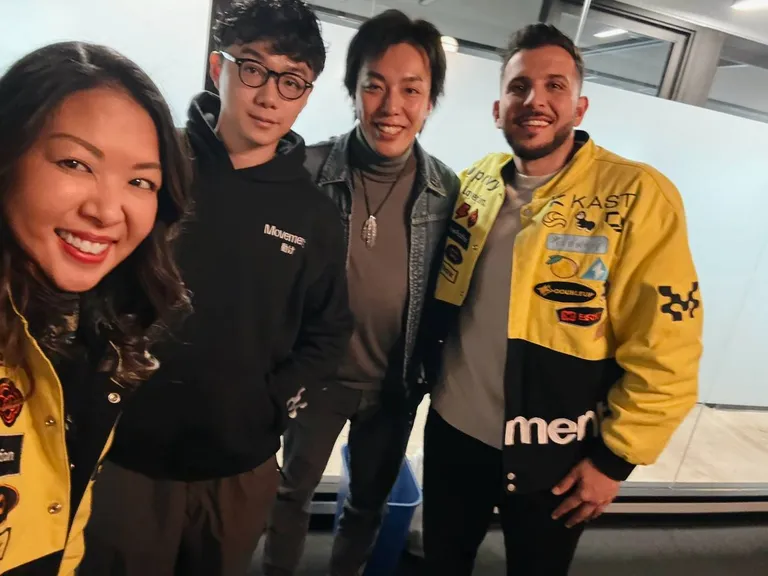
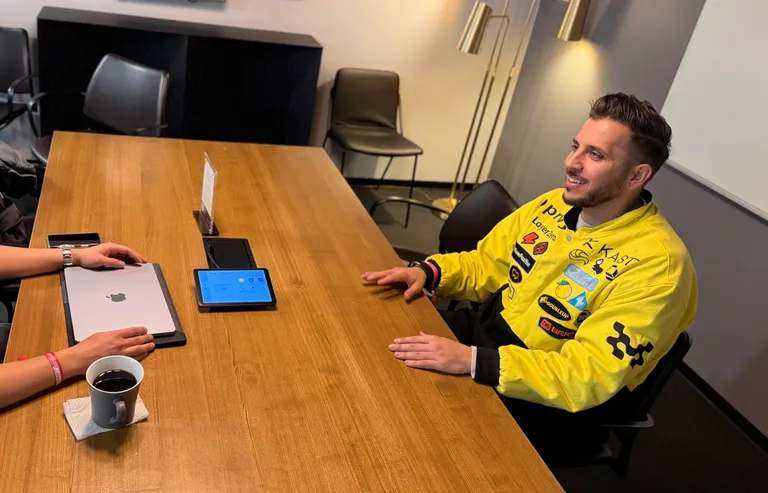
During the interview, Torabi faced my questions throughout in an extremely gentlemanly and polite manner. He listened sincerely to every question and answered while choosing his words carefully. From that姿, his sincerity as a leader came through straight.
In particular, when the topic reached concrete business opportunities in Japan, his proactive posture, leaning forward, was impressive. It made me confident that behind his politeness, he also has overwhelming speed and decisiveness as a manager.
There is one more point through this interview where I strongly felt “what is Movement like.” It is the quality of the swag (novelty goods) they distribute.
Even compared to other projects, Movement’s goods clearly stand out in design and craftsmanship, and frankly they are extremely stylish. While many projects simply print a logo on a ready made T shirt, they add details such as embroidered logos, and they are thoroughly particular down to fine tailoring.
I myself have handled goods from nearly 100 projects so far, and their level of completion is undoubtedly top class.
After the interview ended, in the elevator, I suddenly became curious and asked him.
“Your goods design is always excellent, do you have an in-house dedicated designer?”
Torabi’s answer was immediately “Yes.” The designer is based in San Francisco. Not only cutting edge products, but also the details of the “experience” that the community actually touches, designed carefully with no corner cutting. That thorough brand philosophy was condensed into that single word.
Moving different.
📍 Denver, CO pic.twitter.com/1kjGrFrx8R
— The Movement (@movement_xyz) February 18, 2026
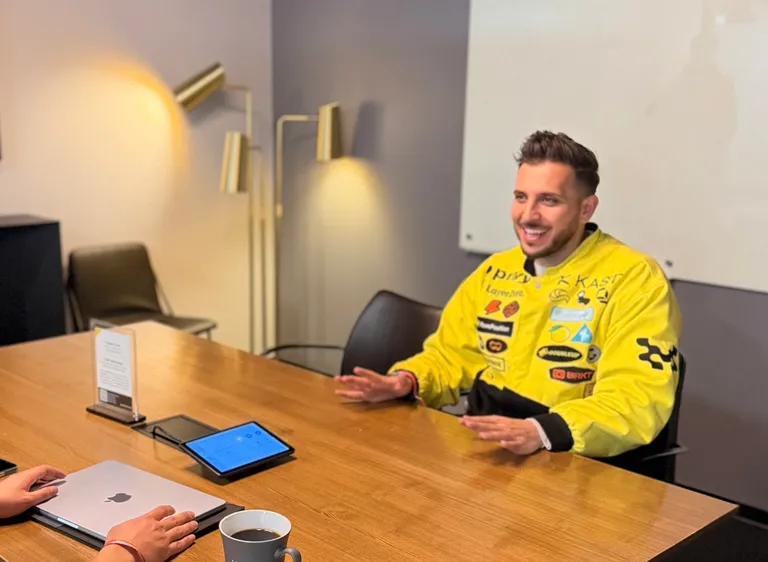
* A Movement original jacket inspired by the racing jackets worn by team members during ETHDenver.
Additional Note: A Cultural Crossroads
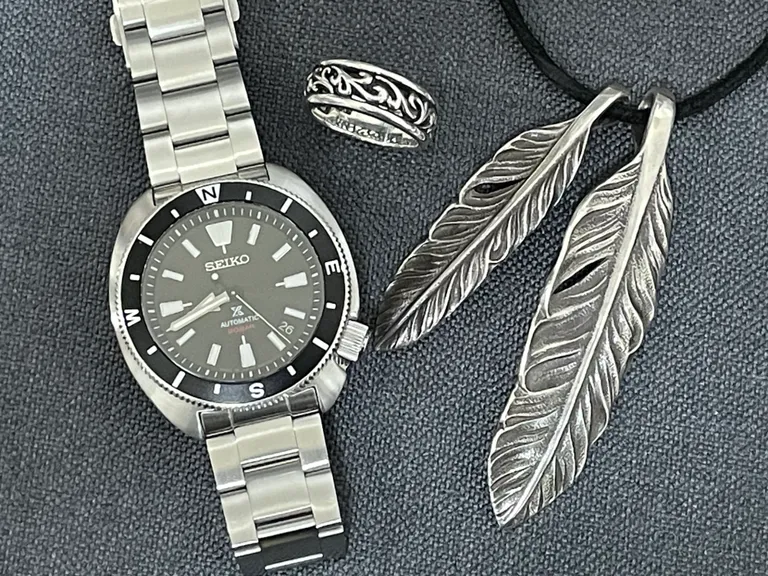
I would also like to note a small, heartwarming moment that happened during the interview. Joe, who was present from the Singapore base, saw the “Lynch Silversmith” feather necklace around my neck and immediately asked with shining eyes, “Is that goro’s?”
In fact, before, I once got excited talking about goro’s with another project related person based in Taiwan. Japanese silver jewelry and street culture have penetrated so naturally and deeply among them who work at the forefront of the Asian crypto scene.
They chase cutting edge technology, and Japan’s craft culture (craftsmanship). I once again felt a cross border cultural connection in that unexpected point of contact.
Pick up

ニュース/解説記事
-

ALL
-

NFT
-

Web3ゲーム
-

DeFi
-

取引所